With Rohit Sharma and Virat Kohli gradually stepping away from the shortest format, the Indian team stands at a crossroads. The decision is not merely about captaincy but about defining the identity of India’s T20 side for the years to come.
Hardik Pandya: The Natural Successor
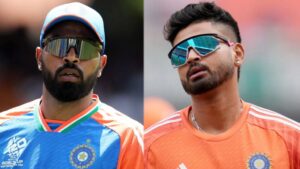
Hardik Pandya’s case for T20I captaincy appears, at first glance, straightforward. He is a proven match-winner, a fast-bowling all-rounder — a rare commodity in Indian cricket — and already has experience leading India at the international level.
His leadership credentials were cemented during his tenure with the Gujarat Titans, whom he led to an IPL title in their debut season and a runners-up finish the following year. Pandya’s captaincy style is instinctive and aggressive, mirroring the modern T20 ethos. He backs his players, makes bold bowling changes, and is unafraid to take responsibility in crunch moments.
On the field, Hardik leads from the front. His ability to contribute in all three facets — batting, bowling, and fielding — offers balance to the XI and flexibility to the team management. In a format where adaptability is king, Hardik’s multi-dimensional skill set is a compelling asset.
However, concerns linger. Injuries have frequently disrupted his availability, raising questions about long-term continuity. Additionally, his leadership style, while fearless, has sometimes been perceived as reactive rather than tactical, particularly in high-pressure international games.
Shreyas Iyer: The Tactical Thinker
Shreyas Iyer represents a contrasting leadership model — one rooted in composure, planning, and clarity of roles. While he has not captained India in T20Is extensively, his leadership credentials in domestic cricket and the IPL are hard to ignore.
Iyer has led teams to success across formats, including guiding Kolkata Knight Riders and Delhi Capitals through transitional phases. His calm demeanor under pressure and strong communication skills have earned praise from teammates and coaches alike.
Unlike Hardik, Iyer is a pure batter, which can be seen both as a limitation and a strength. While he does not offer bowling options, it allows him to focus entirely on leadership and anchoring the batting order. In an Indian setup brimming with all-rounders, this specialization may not be a disadvantage.
Critics, however, point to Iyer’s strike-rate concerns in T20 cricket, particularly against high pace and short-pitched bowling. In a format increasingly driven by explosive batting, his ability to consistently dominate attacks at the international level remains under scrutiny.
Leadership Styles: Instinct vs Structure
The Hardik-Iyer debate ultimately boils down to philosophy.
Hardik embodies the modern T20 captain — expressive, fearless, and adaptable on the fly. His presence aligns with India’s push toward a more aggressive brand of cricket, shedding conservative tendencies of the past.
Iyer, on the other hand, offers stability and structure. His leadership style emphasizes preparation, match-ups, and long-term planning. For a relatively young Indian squad still finding its feet post-transition, this steadiness could prove invaluable.
What Do Selectors Want?
The BCCI’s recent selections suggest a willingness to rotate leadership depending on format and opposition. Yet, with a major ICC tournament on the horizon, clarity will soon be required.
If selectors prioritize impact, flexibility, and star power, Hardik Pandya remains the frontrunner. If they seek consistency, tactical acumen, and long-term availability, Shreyas Iyer presents a compelling alternative.
There is also the possibility of a hybrid approach — Hardik leading when fit, with Iyer as a vice-captain or rotational leader — though such arrangements often lack the clarity needed for tournament success.
The Road Ahead
India’s T20I leadership dilemma reflects a broader transition within the team. The choice between Hardik Pandya and Shreyas Iyer is not about superiority but suitability. One represents the explosive present; the other, a composed future.
As Indian cricket continues its search for the perfect T20 formula, the captaincy decision may well define not just results, but the very character of the team in the years ahead.Read more
 As Indian cricket charts its course toward the next T20 World Cup, one question continues to dominate discussions in boardrooms, dressing rooms, and television studios alike: